
 2026 Holiday Advertising Playbook for Advertisers - Make Every Holiday Moment Count!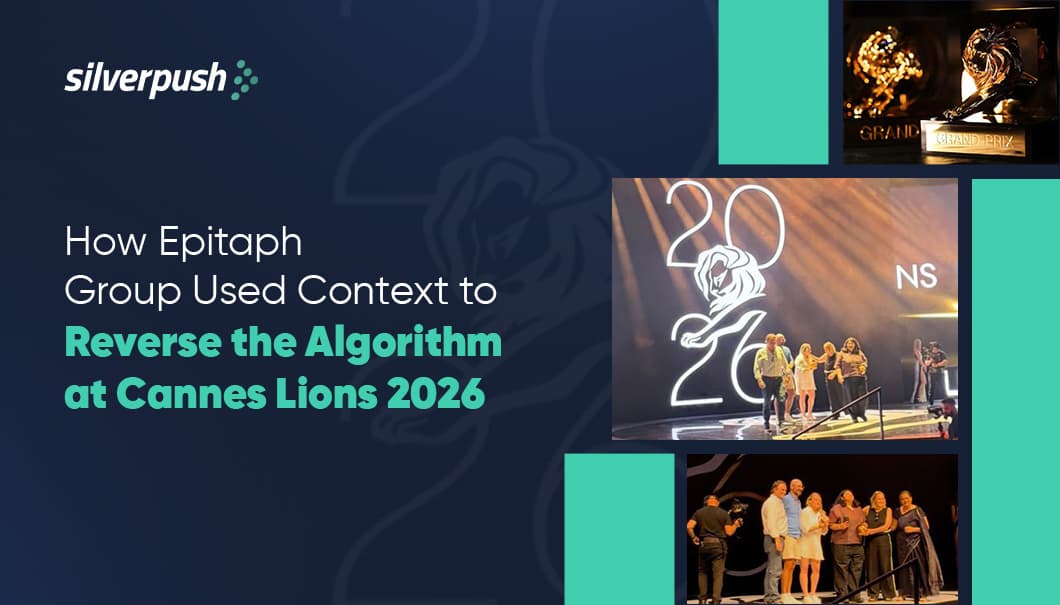
Every serious conversation at Cannes Lions 2026 circled the same tension: creativity and connectivity across screens. Audiences are scattered across a multiplying number of devices, and the data infrastructure the industry spent two decades building to follow them is quietly coming apart. Safari and Firefox already block third-party cookies by default, and an IAB State of Data survey found roughly 95% of industry respondents expect signal loss to keep growing regardless of what Chrome does next.
So the question on the Croisette this year wasn't "What's the next channel?" It was harder: how do you reach people and earn their trust when you can no longer simply track them from screen to screen?
We found the most useful answer of the week in the last place you'd look for a media lesson.
It came from a charity, and it worked precisely because it stopped trying to target people and started trying to understand them.
The campaign ran for a children's mental health charity. The idea underneath it belongs to everyone in the room.
The hardest audience to reach is the one that doesn't want to be found
Kids Help Phone is Canada's only national, free, 24/7, confidential, and multilingual mental health service for youth.
Its problem was quiet and severe.
Self-harm-related emergency visits among Canadian youth rose 975% in six years. Outreach to the service never rose to match. And the adults nearby couldn't see it: 94% of parents rate their kids' mental health as "good," while one in two youth say they're coping alone.
So where was the gap? Not access.
Language.
Self-harm sits behind shame and fear, and you cannot target someone into a conversation they don't have the words to start. So the brief changed shape. Not buy reach. Meet young people in the moment they're struggling, and help them say the thing they can't.
First, they reversed the algorithm
Most brands treat context as a fence. A list of places not to appear. Brand-safety systems exist to keep ads away from hard content.
This campaign walked straight toward it. On purpose.
The brief to Silverpush was simple to say and hard to do: reverse the algorithm. Instead of avoiding sensitive, self-harm-related content, find it, and reach the young people already watching. Not to sell them anything. To offer a way to reach out.
"We came to Silverpush with the initial idea to reverse the algorithm on YouTube, so we could target content that was deemed brand unsafe," says Scott Stewart, Executive Vice President at Epitaph Group. "This campaign is proof that smart-tech can be used for good, and we value Silverpush's partnership in our journey to winning at Cannes Lions."
That meant building a custom contextual universe around emotional distress, with AI and human review working side by side, so the targeting stayed precise, and the handling stayed careful.
Now, you might read that as a one-off for a cause. It isn't.
Context does more than keep a brand safe. It tells you what a person is feeling in the moment you find them, and feeling drives action. Across 60M+ YouTube impressions studied with Lumen Research, contextually aligned campaigns earned 37% higher attention per mille than benchmarks.
Match the content to the moment, and people look up.
Then, they let the data write the message
Reaching the moment is half the job.
The other half is what you say when you arrive, and that's where most campaigns quit. Data goes to who and where. It rarely goes to what.
This one closed the loop. More than 50 million anonymized conversations were mined not for a segment, but for language: the actual words young people use for what they feel. That became 1,028 definitions of "help." And those definitions became the creative.
As Media Lions president Sindhuja Rai noted, the data revealed what young people were going through, and the campaign built its message from there.
Did it work? The numbers aren't subtle.
Donations rose 87% year on year—the biggest jump in the organization's history. Trust climbed nine points. The work took two gold lions and a silver at Cannes.
Here's the lesson, and it travels to any brief: if your data feeds the media plan but never the creative, you're spending half of what you paid for.
The result is relevance, the one edge that survives
Stack those two moves, and you get relevance. Which happens to be the one thing that holds when tracking falls away.
You can see it in the platform itself. On FeelingsToText.ca, young people watched first-hand stories of self-harm and recovery. Interactive subtitles let them tap the feelings they recognized, and those taps assembled into a message they could send straight to a crisis responder.
The blank screen stopped being a wall. No one had to find the words alone.
Strip away the subject, and the rule is the same for everyone. As identifiers fade, your edge isn't knowing more about who someone is. It's being relevant to where their head is when you reach them.
Meeting the mindset beats chasing the individual.
For years, contextual intelligence has been sold as precision: the right person, the right moment, and no personal data required. This work is a reminder of what the precision is for. The signals that tell a brand someone is ready to buy can tell a service someone is ready to reach out.
So maybe the question was never the one we kept asking.
Most ad tech asks: did they buy? The best work at Cannes this year asked a better one.
Did we understand them?