
 2026 Holiday Advertising Playbook for Advertisers - Make Every Holiday Moment Count!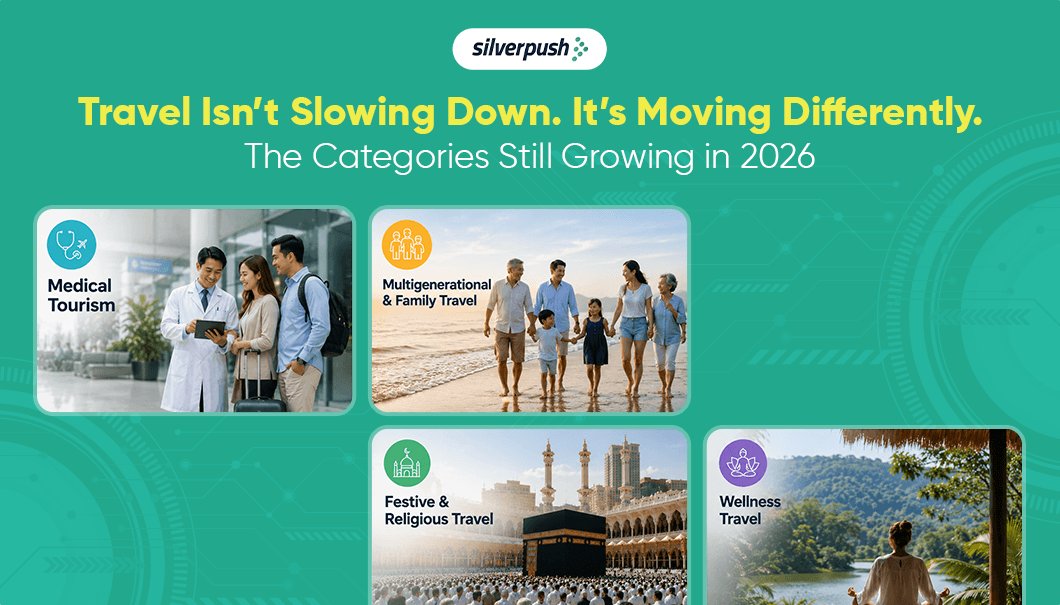
Travel in 2026 looks different from what it did even two years ago. Trips are getting longer, destinations are getting closer to home, and travelers are becoming more deliberate about why they go and where they spend. The headline concerns around inflation and softer consumer confidence are real, but they tell only part of the story. The travel and tourism industry contributed a record $11.1 trillion to global GDP in 2024, and 84% of travelers plan to travel the same or more in the year ahead.
What's changing isn't whether people travel. It's how, when, where, and why.
According to Silverpush's Destination YouTube: Travel Playbook for Advertisers 2026, the travel market is reshaping in three meaningful directions. Trips are becoming longer and more deliberate, with high-income households cutting their longest-trip budgets by 16% while keeping travel intact as a category. Domestic and regional travel is rising, with U.S. domestic travel now accounting for 87% of total travel spending. And travelers are increasingly skipping crowded hotspots, with 55% of Europeans now seeking less popular destinations.
Fewer trips. Longer stays. Closer destinations. Travelers aren't spending less. They're spending differently.
Where the Resilience Lives
Even more interesting than the macro reshape is what's happening underneath it. While headline travel volume softens, several categories are not just holding strong; they're actively growing through the economic squeeze. For advertisers, this is where one of the biggest underleveraged travel marketing opportunities lies in 2026.
Medical tourism is on track to reach $110 billion in 2026 at an 18.4% CAGR, driven by rising treatment costs in high-income countries pushing travelers toward Asia-Pacific's strong medical networks. For hospital networks, insurers, and airlines, the opportunity lives in contextual moments around treatment research, recovery planning, and cross-border care comparisons.
Multigenerational and family travel continues to climb, with 92% of parents planning trips with their children in the next 12 months, the highest level since the pandemic. Family reunions, beach holidays, and grandparent-led trips have become recession-resistant in a way casual leisure travel is not. Resorts, cruise lines, and tourism boards can show up inside family vacation planning, reunion content, and kid-friendly destination research.
Festive and religious travel moves on its own calendar. Saudi Arabia welcomed 18.5 million Hajj and Umrah pilgrims in 2025, and India's religious tourism market is projected to reach $60 billion by 2030. Faith and homecoming drive travel that economic cycles do not interrupt. For airlines, OTAs, and tour operators, this category creates predictable activation windows around pilgrimage content, hometown return travel, and festival destination guides.
Wellness travel has become a $894 billion category growing twice as fast as traditional tourism, with travelers spending significantly more per trip than the average leisure traveler. Luxury hotels, retreat operators, and premium hospitality brands find their audience inside retreat reviews, yoga and longevity content, and slow-travel documentaries.
These categories share a common thread. They are driven by purpose, meaning, or necessity rather than discretionary impulse. And that makes them remarkably resilient to broader economic pressure.
What This Means for Advertisers
A medical traveler, a multigenerational family, and a pilgrim live in completely different content worlds with different planning windows and different signals of intent. Targeting them as one undifferentiated "traveler" segment leaves real performance on the table.
This is where Silverpush’s contextual intelligence becomes the bridge. As the 2026 Travel Playbook outlines, video has replaced the brochure, the agent, and the search bar. Brands that show up inside the specific content moments where these resilient travelers are already planning will win attention that converts.
The travel market isn't shrinking. It's getting more selective. The advertisers who understand which moments still matter will be the ones still booked when the noise settles.