
 2026 Holiday Advertising Playbook for Advertisers - Make Every Holiday Moment Count!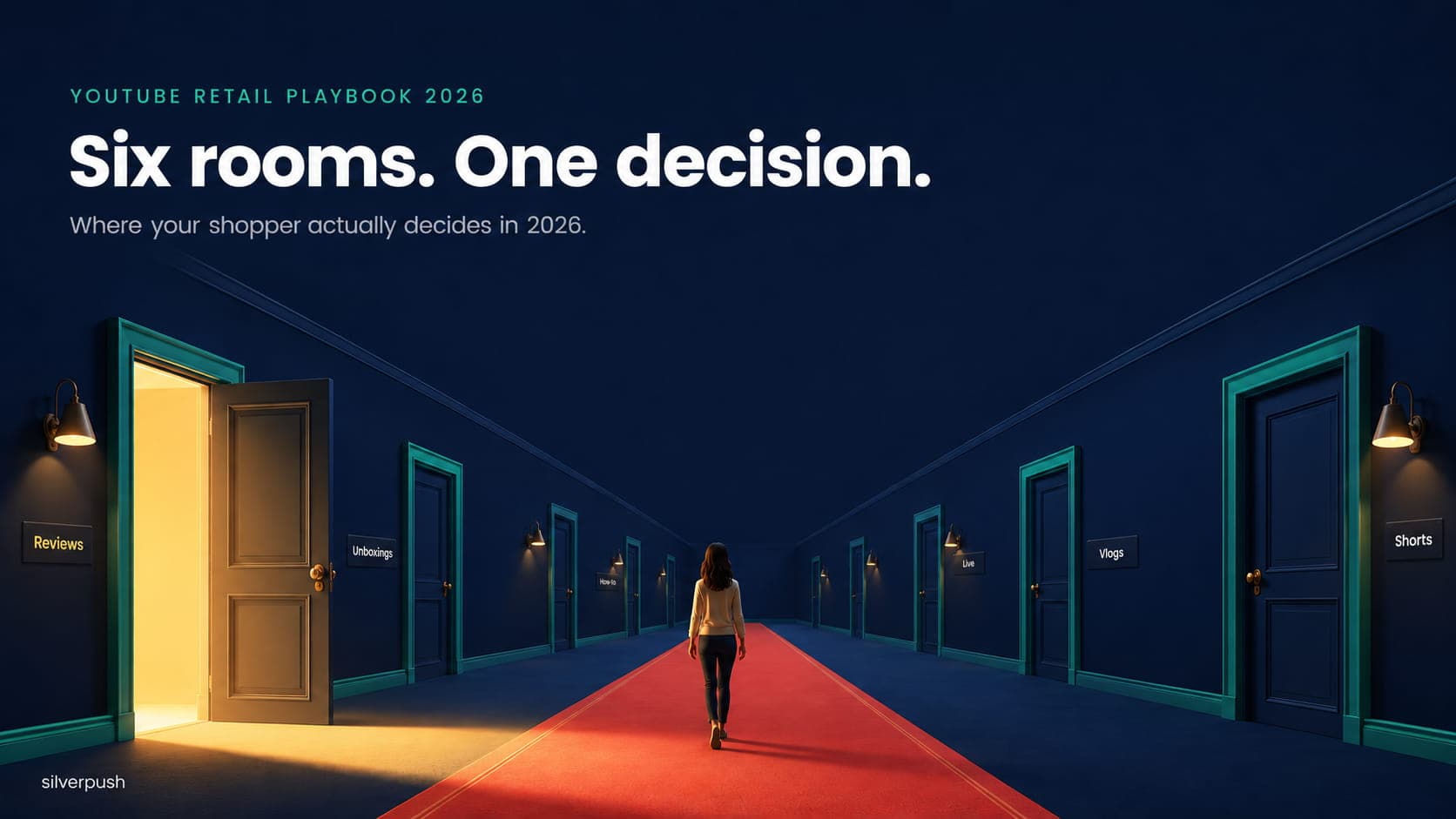
Think about the last thing you bought online. Not the checkout, the part before it: the review you watched twice, the unboxing you didn't need, and the Short that talked you into something you weren't even shopping for.
That half-conscious stretch of watching is easy to dismiss as a detour to the purchase. It isn't. It is the purchase, and it happens on YouTube more than anywhere else.
The scale is the surprise, though. According to Silverpush’s 2026 Retail Playbook, in just twelve months, retail content on YouTube pulled 1.43 trillion views, up 41% year over year, across 25.5 million videos-every one of them someone doing what you just did.
The question was never whether your shopper is watching. That's settled. The real question is "where" because a single shopper's buying life now plays out across seven kinds of retail content, each landing at a different point in the day. And this is where it happens.
Where the Money Changes Hands
The two biggest categories are also the two closest to the "buy" button. Product reviews pulled 373 billion views and carry the highest purchase intent on the platform, with tech unboxing videos just behind at 327 billion.
That tracks with how people decide. Few of us take the brand's word for anything; we go looking for someone who already owns the thing. Almost everyone does: 91% to 97% of shoppers check reviews before buying, per NielsenIQ and eMarketer. And they rarely check once. eMarketer found people research a product at least three times before committing, nearly a quarter of them five times or more.
Five times. Whatever tidy funnel you've drawn in your decks, the shopper isn't walking through it. They're circling, and reviews and unboxings are where that circling happens.
Where It All Starts
Before that circling begins, something has to catch the eye, usually before the shopper is even looking.
Short-form is the engine. Retail Shorts racked up 310 billion views, the fastest-growing format on YouTube, and the pace is remarkable: YouTube told Cannes Lions in 2025 that Shorts now draw roughly 200 billion views a day, up from about 70 billion a year earlier. Nearly triple, in a year.
None of it feels like shopping: a thumb, a feed, fifteen seconds, a want that wasn't there this morning. By the time our shopper is deep in a review, the Short has done its job.
The Part That Earns Trust
Between the spark and the sale, something slower happens: the shopper decides whether to trust you. Three categories do that unglamorous work, and brands overlook all three.
-
How-to videos (140 billion views) earn trust by being useful before they sell.
-
Shopping vlogs (110 billion views) tuck products into real lives, so a recommendation sounds like a friend, not a banner.
-
Fashion hauls (103 billion views) keep browsing a spectator sport, even as a louder culture of mindful spending reshapes what people will admit to wanting.
Together, these formats demonstrate why a strong retail content strategy isn't about creating more content-it's about showing up in the moments that build familiarity before purchase.
What unites them is what they don't do: hard-sell. That restraint is the point. When the shopper is finally ready, yours is the familiar name.
The One to Watch
Occasionally the whole sequence folds into a single moment. That's live streaming: 62 billion views and the fastest-growing category of the seven. A good live session runs the whole loop, discovery to purchase, in one real-time window. Still early in most Western markets, but a curve this steep is one to watch early.
As video commerce continues to evolve, live shopping and interactive formats are bringing content and transactions closer together than ever before.
So Who Is This Shopper?
Here's the part that reframes everything. Line the seven categories up, and you're not looking at seven audiences. You're looking at one person, in seven moods, across a single day.
Our shopper researches on their phone before coffee: 57% to 59% now use generative AI for shopping tasks, per Omnisend. They second-guess over a review at lunch, get pulled back by a Short by afternoon, and buy on their phone that night, as most of the country did last holiday season: Adobe says mobile drove 56.4% of a record $257.8 billion in US online spending. Then YouTube on the TV before bed, part of the billion-plus hours on living-room screens daily.
Same shopper throughout, on a different screen at a different hour. That's the modern retail customer journey. The categories aren't options to choose between. They're rooms the shopper moves through.
The Moment You Paid For Probably Isn't the One That Worked
That movement is what makes the modern sale hard to credit. Touch a product a dozen times in a day like this, and the impression you bought and reported on is rarely the one that closed it — just a stop on a loop you never saw.
Reach alone can't fix that, not when attention is this fragmented and this dependent on what's onscreen. The fix is showing up in the right content, at the right point in the loop, often enough to become the familiar name. Which is why context keeps climbing the media agenda: as third-party signals fade, 49% of marketers told eMarketer that contextual targeting only matters more.
Working out where that attention lives is the easy part; you've just done it. Meeting the shopper there, across every retail category and every moment, is the real work.
Meet Ally
Our shopper has a name. In the playbook, she's Ally: 28, lives in New York City, cart open from before morning coffee to past midnight. One shopper, and every shopper.
A Day in the Cart follows Ally through a single day: the six moments that quietly decide what she buys, all seven categories in full, seven real campaigns (view-through rates up to 94%), and a contextual plan you can run Monday.
You've seen the shape of her day. The rest is inside. Download A Day in the Cart, the 2026 YouTube Retail Playbook.