




How Travel Is Reshaping in 2026: Where the Demand Is Still Growing
PUBLISH DATE: 05 June 2026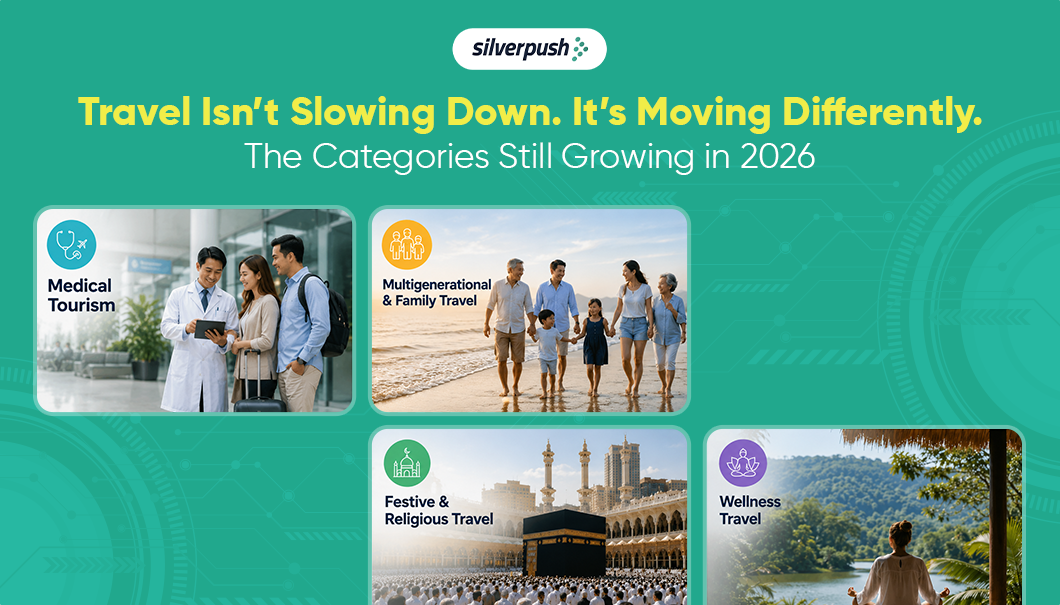
Travel in 2026 looks different from what it did even two years ago. Trips are getting longer, destinations are getting closer to home, and travelers are becoming more deliberate about why they go and where they spend. The headline concerns around inflation and softer consumer confidence are real, but they tell only part of the story. The travel and tourism industry contributed a record $11.1 trillion to global GDP in 2024, and 84% of travelers plan to travel the same or more in the year ahead.
What’s changing isn’t whether people travel. It’s how, when, where, and why.
According to Silverpush’s Destination YouTube: Travel Playbook for Advertisers 2026, the travel market is reshaping in three meaningful directions. Trips are becoming longer and more deliberate, with high-income households cutting their longest-trip budgets by 16% while keeping travel intact as a category. Domestic and regional travel is rising, with U.S. domestic travel now accounting for 87% of total travel spending. And travelers are increasingly skipping crowded hotspots, with 55% of Europeans now seeking less popular destinations.
Fewer trips. Longer stays. Closer destinations. Travelers aren’t spending less. They’re spending differently.
Where the Resilience Lives
Even more interesting than the macro reshape is what’s happening underneath it. While headline travel volume softens, several categories are not just holding strong; they’re actively growing through the economic squeeze. For advertisers, this is where one of the biggest underleveraged travel marketing opportunities lies in 2026.
Medical tourism is on track to reach $110 billion in 2026 at an 18.4% CAGR, driven by rising treatment costs in high-income countries pushing travelers toward Asia-Pacific’s strong medical networks. For hospital networks, insurers, and airlines, the opportunity lives in contextual moments around treatment research, recovery planning, and cross-border care comparisons.
Multigenerational and family travel continues to climb, with 92% of parents planning trips with their children in the next 12 months, the highest level since the pandemic. Family reunions, beach holidays, and grandparent-led trips have become recession-resistant in a way casual leisure travel is not. Resorts, cruise lines, and tourism boards can show up inside family vacation planning, reunion content, and kid-friendly destination research.
Festive and religious travel moves on its own calendar. Saudi Arabia welcomed 18.5 million Hajj and Umrah pilgrims in 2025, and India’s religious tourism market is projected to reach $60 billion by 2030. Faith and homecoming drive travel that economic cycles do not interrupt. For airlines, OTAs, and tour operators, this category creates predictable activation windows around pilgrimage content, hometown return travel, and festival destination guides.
Wellness travel has become a $894 billion category growing twice as fast as traditional tourism, with travelers spending significantly more per trip than the average leisure traveler. Luxury hotels, retreat operators, and premium hospitality brands find their audience inside retreat reviews, yoga and longevity content, and slow-travel documentaries.
These categories share a common thread. They are driven by purpose, meaning, or necessity rather than discretionary impulse. And that makes them remarkably resilient to broader economic pressure.
What This Means for Advertisers
A medical traveler, a multigenerational family, and a pilgrim live in completely different content worlds with different planning windows and different signals of intent. Targeting them as one undifferentiated “traveler” segment leaves real performance on the table.
This is where Silverpush’s contextual intelligence becomes the bridge. As the 2026 Travel Playbook outlines, video has replaced the brochure, the agent, and the search bar. Brands that show up inside the specific content moments where these resilient travelers are already planning will win attention that converts.
The travel market isn’t shrinking. It’s getting more selective. The advertisers who understand which moments still matter will be the ones still booked when the noise settles.
Winning the Travel Moment: YouTube Advertising Strategies for 2026
PUBLISH DATE: 25 May 2026
A traveler hasn’t searched for flights yet. They haven’t compared hotels. They haven’t even picked a destination.
But they’ve already decided where they want to go.
They decided it three weeks ago, watching a creator walk through the streets of Lisbon. Or scrolling a 30-second Short of a beach in Thailand. Or getting lost in a food vlog that made a city feel unmissable.
By the time they open a booking site, the shortlist is written.
And most travel ad budgets are still waiting at the finish line.
1 in 4 travelers now begin travel discovery based on a mood, aspiration, or experience rather than a specific destination. Not a place. A feeling.
As the Silverpush Travel Playbook 2026 makes clear, identifying that intent before the booking journey fully forms is now the defining challenge for advertisers. And the biggest opportunity.
But to act on it, you first need to understand why the old way of planning no longer works.
The Funnel You’re Optimizing For No Longer Exists
Travel planning used to follow a logic. Awareness, then consideration, then booking. Brands knew where they stood and when to show up.
That logic is gone.
Today’s traveler loops. They dream, get distracted, restart, compare, abandon, and come back. Silverpush’s proprietary travel data puts the average number of touchpoints before a booking at 140 to 270, spanning ad exposures, video views, searches, comparisons, retargeting, and clicks across the journey. Each one is a moment where a brand could show up or miss entirely.
The challenge isn’t scale. YouTube alone delivers over 700 million monthly unique travel impressions globally. The challenge is timing. Most travel ad campaigns activate around the last few steps of a journey that started weeks earlier, in content that looks nothing like a travel ad. Vlogs, creator routines, celebrities in exotic destinations, food and lifestyle videos that quietly shape where travelers want to go next. By the time brands show up, intent has already hardened somewhere else.
If the journey is this fragmented, who exactly are you trying to reach along the way?
Six Traveler Personas. Six Different Conversations.
Not every traveler is dreaming about the same thing. And not every traveler is watching the same content to get there. Silverpush has found six specific traveler personas based on what the audience is watching, how they’re engaging, and what they end up booking:
- The Culture Seeker is watching documentaries and local history vlogs. They are not inspired by price. They are inspired by curiosity and passion for specific places.
Contextual Strategy: Target specific regional documentaries, history influencers, and historical footage related to the destination. - The Food Traveler found their next destination through a street food channel, not a travel brand. They are already emotionally sold on a place before they have looked at a single hotel, and it’s usually based on the meals they want.
Contextual Strategy: Build a media plan around foodie and cultural content that aligns with the target destinations, enabling the food traveler to reach their dream dish. - The Adventurer is researching gear, routes, and physical challenges. It’s not about luxury and leisure for this group; it’s all about exploration and thrills.
Contextual Strategy: Align with outdoor and extreme sports content specific to the destination. - The Budget Traveler is highly engaged with content that helps them plan and keep costs down. They are often looking for family-friendly destinations, domestic travel destinations, and local routes.
Contextual Strategy: Reach the travelers who want to keep costs down by delivering relevant ads to local area destinations, family destination content, and similar videos. - The Luxury Seeker decides on a feeling and on what’s trending in luxury circles. Luxury travel advertising works best on the big screen, where CTV creates the emotional pull of a destination that justifies a premium price before a traveler has compared a single rate.
Contextual Strategy: Deliver splashy, high-quality creative to high-quality YouTube channels that are aligned with luxury brands and influencers. - The Family Traveler is the most deliberate buyer in the market. They research longer, compare harder, and prioritize safety and accessibility above everything else. They are also one of the highest-value segments for travel brands willing to meet them with the right message at the right moment.
Contextual Strategy: Plan your media strategy for the video content that’s being watched together as a family, as well as mom influencers, parenting influencers, and advice on raising a family.
Five Things That Actually Move the Needle in 2026
The brands winning on YouTube in 2026 are not necessarily the ones with the biggest budgets. They are the ones with a precise YouTube advertising strategy that allows them to reach the right audiences at the most relevant moment.
Here are five key YouTube contextual strategies that can help deliver audiences to their destinations:
1. Get in before the crowd does.
Travel intent builds well before booking peaks. By the time CPMs spike heading into summer, competition for high-intent inventory is already expensive. Brands that activate early and based on what’s trending can reach the same audiences at materially lower cost.
2. Stop thinking in travel categories.
Remember the food vlog that made a city feel unmissable? That wasn’t a travel ad, but it still drove a travel decision. A traveler deep in a wellness channel is thinking about where to go next. A viewer watching a fashion haul set in Tokyo is already imagining the trip. Food, fashion, fitness, and local events all shape travel decisions long before a flight is searched. Expanding into these adjacent contexts is one of the most underleveraged opportunities in travel advertising: capturing intent before it becomes obvious and before competitors are anywhere near it.
3. Shorts are where discovery begins.
Travel video advertising on YouTube has shifted decisively toward short-form content. More than three-quarters (79%) of travel views now come from Shorts. This is where the Lisbon creator video lives. Where the Thailand beach Short lives. Shorts are scroll-native and, increasingly, the first touchpoint in a journey that ends in a booking. While view-through rates are lower, so are CPMS, which means you can scale awareness by investing in a YouTube Shorts campaign.
4. Different screens are doing different jobs.
The traveler who watches a Short on their phone is not in the same mindset as the one researching on a laptop or watching on a connected TV. CTV builds aspiration. Mobile drives comparison and consideration. Desktop closes the booking. Running the same creative across all three does not cover the journey. It flattens it. Platform-specific creative can help drive higher performance and a better viewing experience.
5. Partner with creators; do not compete with them.
The vast majority (95%) of top travel content on YouTube is creator-led. Travelers trust individuals, not brands. The creator walking through the streets of Lisbon has already earned the audience’s attention. The most effective travel strategies do not try to out-produce that. They build alongside it, using contextual adjacency to borrow the credibility that creators have already earned.
Put these five principles together, and a pattern emerges. Every single one is about closing the gap between where intent lives and where your brand shows up.
Relevance Is Now the Price of Entry
Global travel demand has never been higher. But demand alone does not guarantee a booking goes to your brand.
The traveler is already being influenced. Already building a shortlist. Already moving through hundreds of content moments before they get anywhere near your retargeting window. The brands that show up in those early moments do not just build awareness. They shape the decision before the competition has entered the room.
Reach is abundant. Relevance is a scarce resource.
Contextual intelligence engines like Silverpush help travel advertisers decode intent signals across YouTube in real time, connecting contextual data to campaign activation so brands can act in the moment, not after it has passed. For brands serious about travel YouTube advertising in 2026, the ability to act on early intent is where the real advantage is built.
Want the full picture? The Silverpush Destination YouTube 2026 travel playbook covers regional demand breakdowns, category-level growth data, and the complete contextual targeting framework behind everything in this piece. Download it before the summer planning window closes.
What Silverpush Saw at Cairns Crocodiles 2026: The AI Conversation Finally Got Honest
PUBLISH DATE: 21 May 2026
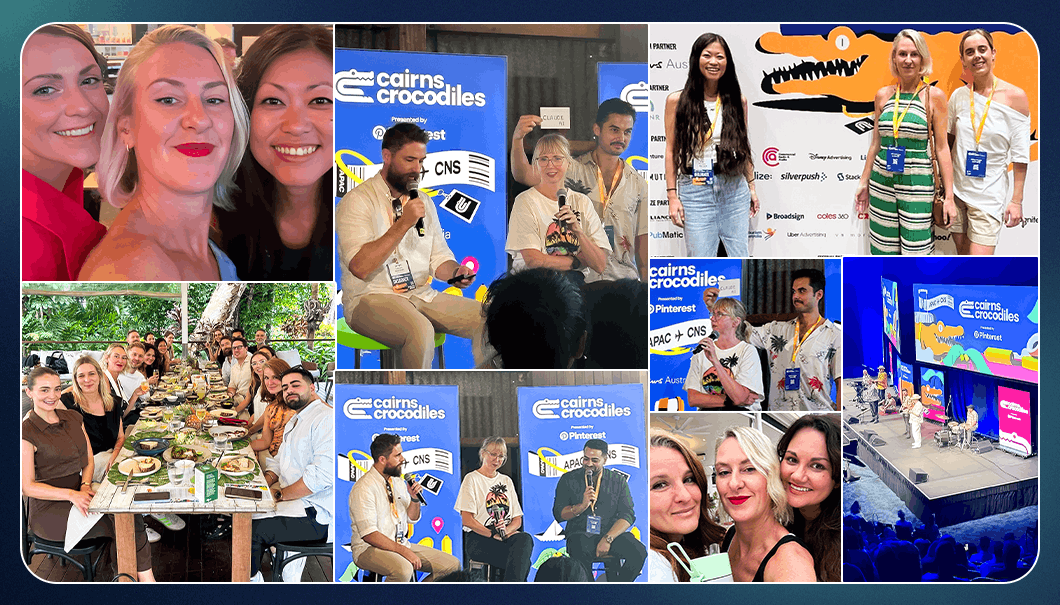
Last week, the Silverpush team was on the ground at Cairns Crocodiles 2026 for three days of panels, networking, beachfront conversations, and one very public ChatGPT meltdown. (More on that in a moment.)
The festival drew over 2,100 attendees this year and added two new tracks: Travel Marketing and Film & Screen. The agenda spanned attention recession, brand-as-culture, artists’ rights in an AI age, sustainability as leadership, and protecting Indigenous cultural IP. Six conversations on paper. In the corridors, one. How real is the AI shift, and how do we use it without breaking something we cannot fix.
Here’s what we took home.
1. The Hemingway’s Panel Set the Tone for the Week
On Day 1, Silverpush hosted a panel at Hemingway’s Brewery under the banner “Bullsh*t vs Reality: 2026 Media Trends”. IAB Australia CEO Gai Le Roy and Chemist Warehouse’s Head of Digital Media Rohan Kohli took the stage with our Silverpush’s Head of Sales ANZ, Jarryd Gaggin, in the moderator’s chair.
A surprise third panellist, ChatGPT itself, was called in to play Celebrity Heads. Introduced live on stage, it promised “sharp takes” and “unexpected angles” before fumbling several questions and collapsing entirely during the game, to roars of laughter from the 100-plus crowd.
The metaphor wrote itself.
“I do worry about this middle period,” Le Roy said. “I do feel for everyone in the industry who is trying to do two or three jobs before the tools are ready to run on their own.” Kohli put it plainer: AI is augmenting his team, not replacing it.
That distinction, between augmentation and autonomy, defined every serious conversation we had across the three days. The industry has finally stopped pretending the tools are ready to run on their own.
2. ANZ Is Leading APAC in Adoption. Most Teams Aren’t Ready for It.
The data underneath the festival mood backs the panel up almost exactly.
ANZ leads APAC in generative AI adoption, with 29% of brands deploying or evaluating it in 2025, doubled from 14% a year earlier. That’s the fastest growth rate in the region.
But only 12% of executives report that operational AI delivers consistent ROI. 59% cite governance and privacy as their top barrier to scaling.
That isn’t a contradiction. It’s the most honest snapshot of a market in transition you’ll see this year. ANZ is moving fast and openly admitting it isn’t ready, which is the most useful thing a region can do at this stage.
3. The Money Is Already Moving Toward Context
If the AI conversation was the headline, the spend data was the under-told story.
Internet advertising in Australia hit $18.4 billion AUD in 2025, growing 11.5% year on year. Video led the charge, climbing 19.8% to $5.4 billion and now representing 29% of total digital spend. Social video jumped 35.1%. The money is leaving the parts of digital that depend on third-party identifiers and pouring into video-rich, content-led environments where contextual relevance actually works.
This is the terrain Silverpush has been built for. AI that reads video at scale, decodes context, and surfaces intent signals without relying on identifiers that are quietly disappearing. Contextual intelligence isn’t a hype topic in ANZ. It’s where the spending is already going.
4. Travel Marketing Earned Its Own Stage. We Brought Receipts.
One of the festival’s biggest shifts this year was the launch of the Travel Marketing Track, signalling that tourism, aviation, hospitality, and destination brands are now central to the regional creative conversation. Sessions covered youth travel rebrands, AI-shaped discovery, and Gen Z engagement, all circling the same question: how do you reach travellers in the moments where decisions actually form?
That’s a question we’ve been mapping. ANZ generated 33 billion travel content views over the past year, growing 28% to 32% year on year, with the region delivering over 17 million monthly impressions of high-value long-haul travellers. 35% of Aussies have booked trips based on inspiration from YouTube, TikTok, and Instagram. Discovery here is video-led, and it starts well before search.
Our newly released ANZ Travel Playbook 2026 maps where that intent peaks across seven travel content categories, who drives demand, and when to activate. A regional tourism brand applying these signals through Silverpush’s Mirrors platform recently drove 160% higher CTR and 18% higher VCR against benchmarks, not by buying more impressions, but by buying the right moments.
Looking Ahead
Cairns 2026 didn’t end the AI conversation. It demanded a better version of it. The brands that win in this market will be the ones who choose AI partners based on what the technology actually delivers, not by how loudly it markets itself.
Huge thanks to Gai Le Roy and Rohan Kohli for being terrific on the panel, to Jarryd for steering it brilliantly, and to everyone who packed Hemingway’s or shared a beachfront chat across the week. See you in the deep end next year.
If your 2026 travel campaign is in build, download the ANZ Travel Playbook here.
Real-Time Trend Intelligence: Turning Signals into Campaign Strategy
PUBLISH DATE: 27 April 2026
Unilever’s YouTube strategy ”branded Desire at Scale” has put numbers behind something most marketers have always suspected: placing brand messages inside cultural moments people are actually watching drives measurable business outcomes. Their data points to a 50% lift in ROI from trending content placement. Not from reaching more people, but from reaching them while attention was live.
That’s the business case for trend intelligence. It isn’t about chasing culture. It’s about making cultural relevance a repeatable, measurable input into the media plan – and turning the attention that forms around a cultural moment into demand, brand lift, and sales.
Why Trending Content Drives Outcomes
Cultural moments concentrate attention in a way that standard targeting can’t achieve. Think about what happens when:
- Taylor Swift wears a specific dress to an event. Overnight, searches spike, retailers sell out, and creators flood YouTube and TikTok with reaction, styling, and try-on content.
- A Labubu doll goes viral. What starts as a niche collector trend compounds into millions of searches, resale economies, and a category-defining moment for an entire year of toy buying.
- Justin Bieber surprises the crowd at Coachella. The livestreams, recaps, and fan reaction content dominate video feeds for days.
- A World Cup match ends in an upset. Within minutes, the conversion moves from sports platforms to mainstream entertainment across every social surface.
These are attention events. People aren’t being interrupted – they’re actively seeking, sharing, and engaging with related content. For advertisers, showing up inside those moments isn’t contextual decoration. It’s positioning a brand where demand is being formed in real time.
Unilever’s numbers aren’t an anomaly. They’re what happens when a major brand treats trending content as a planned media buy rather than an opportunistic insert.
The Pattern Behind Cultural Moments
Cultural moments concentrate attention for a limited window – and the third-party data is clear on why that window matters commercially.
Kantar’s 2026 BrandZ analysis, examining more than 6,000 brands across 100 categories and 30 countries, found that brands in the top quartile for meaningful difference – the combination of salience, relevance, and distinctive experience – compounded brand value at 2.7x the rate of bottom-quartile brands over the past three years.
GWI’s 2026 Zeitgeist study, drawing on 25,000 internet users across 25 markets, adds the behavioural explanation: 74% of respondents say they engage meaningfully only with content that feels personally relevant to the moment, concern, or desire they’re in right now.
Industry data on cultural messaging shows that placing brand communications inside cultural moments delivers +6% higher action and a 1.3x lift in purchase intent versus non-contextual placements.
Relevance isn’t a soft metric. It’s the input that converts attention into business outcomes — and cultural moments are where relevance is most concentrated.
The moments themselves move through four phases, a lifecycle documented in academic research on trend persistence and decay in social media.
Most moments move through four phases:
- Emergence. Early signals appear. Search volume ticks up. A handful of creators or publications start covering it. The trend is real, but most brands haven’t noticed yet.
- Acceleration. Momentum builds rapidly. Content volume surges. Mainstream audiences engage. This is the phase with the highest advertisers’ RIO – attention is rising, the conversation is still forming, and competitive pressure hasn’t caught up.
- Peak. Maximum saturation. Everyone is talking about it. Attention is at its highest, but so is competition for that attention. Ads placed here still perform, but the cost of relevance is higher.
- Decay. Attention scatters. New moments replace it. Brands still running campaigns against the topic start looking late, not relevant.
Duration varies sharply by category. The same academic research puts the median survival time of a trending topic at roughly 6 hours, with topics driven by external events or media coverage persisting longer than internally generated ones.
Sports moments sit at the fast end of that distribution: Twitter engagement runs +26% above baseline during major sporting events, with tentpoles like the Super Bowl concentrating over 1.8 billion impressions and tens of millions of in-event engagements. Entertainment moments – a Coachella surprise set, a series premiere – typically sustain engagement over several days as recap and reaction content spreads. Slower-build cultural moments, like a viral toy (Labubus being a recent example) or a celebrity fashion moment, can accelerate over weeks before peaking.
The takeaway isn’t the curve itself — it’s where to place your brand on it. Trend intelligence earns its value in the acceleration phase: identifying moments while they’re still building and putting brand presence in front of attention before competitive pressure prices it out.
Why Traditional Targeting Misses the Window
Traditional targeting operates on historical signals – what people searched last week, what sites they visited, what audiences they belong to. These work for steady-state campaigns. They don’t work for moments that form and move in hours.
Consider the World Cup upset scenario. A match ends on a Saturday night. By Monday morning, when most campaign managers log in, the conversation has already shifted. The memes have been made. The reactions have been posted. The cultural moment has passed.
Even programmatic buying, which operates at speed, typically relies on pre-defined audience segments and keyword lists. It can’t dynamically detect that a specific topic is accelerating across video content and reallocate placement accordingly.
Trend intelligence closes the gap by monitoring content signals – not user signals – in real time. It watches what’s being created, shared, and engaged with across platforms, and identifies when a topic crosses from background noise into active cultural momentum.
From Intelligence to Activation
Detecting a moment matters less than activating against it. In practice, that looks like:
- Real-time trend detection that continuously scans video and social content to identify emerging topics and tracks their phase of development.
- Contextual alignment that places your ad alongside content that’s thematically relevant to the moment – not just in the same category, but in the same conversation.
- Cross-platform reach that activates the same moment wherever the audience is engaging with it, from YouTube to Meta to TikTok to CTV.
The result is advertising that doesn’t just reach the right people. It reaches them at the moment attention is highest and competitive cost is lowest – which is what Unilever and other major advertisers are optimising for.
What This Means for Your Next Campaign
If you’re planning campaigns for the second half of 2026, the question isn’t whether cultural moments matter for performance. Unilever’s 50% ROI lift and similar numbers coming out of major advertisers have settled that. The question is whether your media infrastructure can act on those moments in real time.
Trend intelligence isn’t about chasing every viral spike. It’s about having the ability to recognise when a moment aligns with your brand, understanding where it sits in its life cycle, and activating against it before the window closes.
In a world where third-party cookies are disappearing, and attention is fragmenting across platforms, contextual relevance is becoming the foundation of performance – not just reach. Trend intelligence is how you make that foundation systematic.
Ready to Turn Cultural Attention into Business Outcomes?
Silverpush’s contextual intelligence engine maps trends in real time across YouTube, social, and CTV, so your brand shows up inside the moments that drive demand. If you’re ready to build cultural relevance into your media plan as a repeatable input, let’s talk.
Summer of Sports 2026: What Brands Need to Know About YouTube & CTV
PUBLISH DATE: 17 April 2026
Summer 2026 isn’t just about one tournament. It’s a stacked cleaned or premium sporting moment – the FIFA World Cup (48 teams, 104 matches, projected 6 billion viewers), Wimbledon, the Tour de France, the F1 British Grand Prix, The Open Championship, and the Premier League returning in August. Each event generates its own wave of content on YouTube, and together, they create a sustained window of high attention that runs from late May through September.
For brands running video campaigns, this is an unprecedented opportunity. But it requires planning that starts now – and a strategy that goes beyond sports channels.
YouTube is the engine room of summer sports
YouTube sees over 40 billion hours of sports content watched annually, and 74% of sports fans visit the platform multiple times a week. This summer, the scale will be even larger: FIFA has named YouTube a preferred platform for the 2026 World Cup, with rights holders able to stream the first 10 minutes of every match live on the platform.
But it’s not just football. Tennis content surges around Wimbledon. Cycling and endurance content peaks during the Tour de France. F1 has one of YouTube’s most engaged fan communities, with pre-race analysis, qualifying reactions, and post-race breakdowns generating millions of views around every Grand Prix. Each event brings its own content ecosystem, highlights, creator commentary, tactical analysis, and fan reactions. Each represents a distinct targeting opportunity.
Sports fans are digital-first and multi-screen
The way fans consume sports has fundamentally changed. Research shows that 83% of fans use a second screen during live events, with 82% active on mobile apps. CTV sports viewing grew 30% in 2024, and TikTok sports fans grew 42% year-on-year.
This is consistent across events. A Wimbledon viewer checking their phone during a rain delay, an F1 fan watching qualifying highlights on YouTube while the race streams on CTV, a football fan scrolling through TikTok reactions at half-time. The behaviour pattern is the same. Fans are omnichannel. Your strategy needs to be too.
The real opportunity is beyond the pitch, the court, and the track
Here’s what most media plans miss: major sporting events generate content waves far beyond sports channels. When the World Cup lands, YouTube sees spikes in fashion (kit culture, matchday outfits).
When Wimbledon arrives, fashion and lifestyle content surges (strawberries and cream, all-white outfits, British summer style). The Tour de France drives cycling gear reviews, travel content about the French countryside, and fitness/endurance videos. F1 race weekends drive travel vlogs, tech reviews, and host city food tours.
For advertisers, this means the most efficient way to reach sports fans often isn’t buying sports inventory directly, where CPMs are highest, and competition is fiercest. It’s reaching fans in adjacent content categories where engagement is strong, attention is high, and costs are significantly lower.
Contextual intelligence makes this possible by identifying sports-adjacent content across video platforms and not through keyword matching, but through analysis of metadata, publicly available entertainment transcripts, and metadata signals that connect the dots between a Wimbledon fashion haul and a tennis fan audience.
A full-funnel approach across every screen
The most effective sports campaigns in 2026 will be built around a full-funnel framework that matches content to screen and objective.
At the awareness stage, CTV and long-form YouTube deliver broadcast-quality reach in lean-back environments. Contextual targeting ensures ads run alongside premium sports content, including highlights, previews, and post-match analysis, across every sport, not just football.
At the consideration stage, mobile YouTube and Shorts are where fans actively engage. Creator reactions, trending topics, and real-time moment targeting reach fans at their most emotionally engaged, whether that’s a World Cup goal, a Wimbledon upset, or an F1 overtake.
At the conversion stage, contextual audience signals feed into performance campaigns, turning engaged sports viewers into customers. Research from Nielsen shows that 67% of fans report increased purchase intent for brands they see alongside sports content, with the effect amplified during emotional peaks.
Five things to do before June
For brands planning their summer sports strategy, the time to act is now, not when the first ball is kicked or the first serve is struck.
First, start planning in May. Pre-event content creates premium placement opportunities weeks before each tournament begins. Squad announcements, draw predictions, route previews, and qualifying coverage all generate high-intent audiences.
Second, go beyond sports channels. Fashion, food, travel, and tech content all spike around major sporting moments. Each event creates its own cross-category ripple. Contextual targeting captures these adjacent audiences at lower CPMs.
Third, think omnichannel. Fans move between YouTube, TikTok, CTV, and social platforms throughout the summer. A connected strategy ensures your brand follows the fan, not just the platform.
Fourth, activate trending moments. Breakout players, surprise results, and unexpected storylines can be detected and activated within hours through trend intelligence. This applies to every event, not just the World Cup.
Fifth, protect your brand. Sports content is emotionally charged and unpredictable across every sport. Full-video contextual analysis ensures brand safety without sacrificing scale.
Download the full playbook
We’ve mapped the full summer sports calendar from the World Cup and Wimbledon through to the Premier League return in August. The playbook includes the data behind each opportunity, a full-funnel strategy framework, and five actionable takeaways you can brief your team on today.

The biggest stage. The biggest moments. One playbook to win it all.
Why TikTok Is the First Screen for Tentpole Moments in 2026
PUBLISH DATE: 23 March 2026
As brands plan for 2026, their calendars are already anchored around major global events. The Winter Olympics. The Super Bowl. The FIFA World Cup. Prime Day. Black Friday. The holiday season.
These moments will command attention and investment. But the way audiences experience them has fundamentally changed.
Tentpole events no longer begin when the broadcast starts. They begin when the conversation starts.
And in 2026, that conversation begins on TikTok.
TikTok has surpassed one billion monthly active users globally, and according to DataReportal, the average user now spends more than 95 minutes per day on the platform. This is not passive viewing time.
It is active participation in culture as it unfolds.
For marketers, this signals a structural shift. Tentpoles are no longer scheduled media spikes. They are dynamic cultural cycles that build, accelerate, and evolve in real time.
Let’s align your brand with key tournaments and fan attention in 2026.
From event day to cultural momentum
There was a time when the tentpole strategy was focused on a single peak moment. Media weight was concentrated around kickoff, opening ceremonies, or midnight retail launches.
Today, tentpoles unfold in phases.
Weeks before the World Cup, creators debate team selections. Ahead of the Super Bowl, speculation about commercials and halftime performances gains momentum across feeds, contributing to the 30% rise in social engagement that major events typically see on platforms like TikTok and Instagram, according to recent analysis.
In the lead-up to Black Friday, shopping lists and product comparisons circulate as users increasingly use social media to research products and deals, with almost 80% of global internet users saying they turn to social platforms to explore brands and products.
During the event, reactions surge instantly. Afterwards, highlights, commentary, and product moments continue to influence behaviour.
TikTok research shows users are significantly more likely to discover new products on the platform compared to other social environments. Discovery and decision are increasingly happening within the same session.
Tentpoles are no longer isolated events. They are living ecosystems of anticipation, reaction, and commerce.
Attention is defined by velocity
One defining characteristic of tentpole moments in 2026 is speed.
Trending topics can peak within 24 to 72 hours. A single play, performance, or viral outfit can reshape global conversation almost instantly.
Attention is no longer just about scale. It is about acceleration.
Traditional campaign planning captures what was trending. TikTok surfaces what is accelerating right now.
By the time a brand reacts to yesterday’s headline, the emotional spike may already have shifted.
This is the reality of what many now call the trending economy. Cultural momentum determines media effectiveness.
Why trend detection matters
In this environment, relevance cannot rely on historical data alone.
According to Deloitte research, more than 60% of Gen Z consumers expect brands to respond quickly to cultural moments online. Responsiveness signals authenticity.
This is where Silverpush’s Trend Intelligence platform becomes strategically important.
Most social listening tools measure volume after a spike. They tell you what has already trended. Silverpush Trend Intelligence measures acceleration before the spike. It identifies abnormal growth patterns in conversations across platforms, including TikTok, detecting cultural momentum as it builds rather than after it peaks.
Instead of asking what was performed yesterday, it asks what is gaining traction right now.
During the World Cup, this could mean identifying a breakout player narrative before it dominates feeds.
During the Met Gala, a fashion theme could surface as it begins accelerating. Ahead of Prime Day, it could reveal product categories showing unusual growth signals.
Trend Intelligence does not just report on culture. It helps brands anticipate it.
In tentpole marketing, that timing advantage can define impact.
Visibility requires contextual confidence
High attention moments also carry higher scrutiny.
Award shows can trigger social debate. Sporting events can become emotionally charged. Retail tentpoles can ignite conversations around pricing or sustainability.
Studies show that 90% of consumers say it’s important for ads to appear in brand-safe environments. Trust influences brand perception directly.
Participating in tentpoles without contextual awareness introduces risk. Participating with intelligent alignment builds credibility.
From cultural signal to confident activation
If Trend Intelligence helps brands understand where momentum is building, Silverpush’s Mirrors for TikTok ensures brands show up within those moments in a safe and relevant way.
Mirrors for TikTok applies AI-powered contextual intelligence to support brand suitability and alignment within the platform’s fast-moving ecosystem. At a high level, it enables brands to engage with meaningful tentpole environments while maintaining contextual safeguards.
The focus is not simply on avoiding unsafe content. It is on identifying environments that reinforce brand values and campaign objectives.
In an environment defined by speed, contextual alignment becomes a growth lever.
Together, Silverpush Trend Intelligence and Mirrors for TikTok create a connected approach to tentpole strategy. One detects emerging cultural velocity. The other supports a confident presence within it.
The result is not just visibility during major events. It is relevant at the right moment, in the right environment.
The first screen advantage
The 2026 calendar will deliver global moments that command massive attention. At the same time, global e-commerce sales are projected to surpass six trillion dollars, reflecting the growing connection between cultural moments and commerce.
But scale alone does not define leadership.
The brands that win in 2026 will be those that understand how tentpoles now behave. They will detect cultural acceleration early. They will align contextually. They will show up where attention is building, not where it has already peaked.
TikTok has become the first screen because it captures anticipation, reaction, and commerce within one continuous cultural loop.
In the trending economy, the first screen shapes perception.
And in 2026, the brands that understand that shift will not simply participate in tentpole moments.
They will lead them.
What 60M+ YouTube Impressions Reveal About Attention and Context
PUBLISH DATE: 03 March 2026
You’re watching makeup tutorials on YouTube.
An ad plays. It’s for a home alarm system.
You skip.
When ads lack context, attention disappears. Media dollars follow.
Silverpush was built to solve this relevance gap for brands, advertisers, and consumers alike. Because when advertising aligns with what someone is already watching, it stops feeling intrusive. It becomes additive. Part of the journey.
We’ve long seen contextual campaigns drive stronger outcomes: higher view-through rates, improved search lift, increased brand lift, and stronger purchase intent.
Now, we’ve validated something more fundamental:
Context drives attention.
The Study: 60M+ Impressions, 39 Campaigns, One Question
To quantify attention performance on YouTube, Silverpush partnered with Epitaph and Lumen Research.
We analysed 60M+ YouTube impressions across 39 campaigns that ran with Silverpush Contextual Intelligence in 2025.
The objective was clear:
Does contextual alignment on YouTube measurably increase attention?
Lumen evaluated performance using three established attention metrics:
- Viewed Rate: Did audiences actually look at the ad?
- Average View Time: How long did visual attention last?
- Attention Per Mille (APM): What was the cost efficiency of attention delivered?
The Results: Context Outperforms Benchmarks
Compared to standard YouTube attention benchmarks, contextual campaigns powered by Silverpush and Epitaph delivered:
- +12% higher viewed rate
- +22% higher average view time
- +37% higher attention per mille
The 37% improvement in Attention Per Mille is particularly significant. It demonstrates that contextual alignment doesn’t just increase engagement — it improves the efficiency of media spend.
This marks one of the first large-scale studies examining whether contextual relevance on YouTube directly correlates with measurable attention lift.
The answer: Yes.
“At Lumen, we know that context is a key driver of attention. This study demonstrates that Epitaph and Silverpush consistently deliver higher relevance, leading to stronger engagement and greater efficiency on YouTube.”
— Donia Baddou, Global VP of Partnerships, Lumen Research
Rethinking the Cost of Attention on YouTube
For years, media evaluation has centred on CPM — cost per thousand impressions. Scale matters. But scale without attention is incomplete.
Attention introduces a more meaningful performance layer.
Two campaigns may deliver similar CPMs and meet viewability thresholds. But if one drives significantly higher attention, it delivers stronger media quality — not just media volume.
The 37% improvement in Attention Per Mille illustrates how contextual placements generate greater engagement efficiency from the same base of viewable impressions.
This shifts the conversation from:
“Did the ad serve?”
to
“Did the ad capture attention?”
From Measurement to Media Strategy
The implications extend beyond reporting.
Following these findings, Epitaph is developing an advanced buying model centred on relevance, context, and attention — not just reach or cost optimisation.
At Silverpush, Lumen’s attention metrics will be integrated as an additional measurement layer for clients. This provides a more holistic view of contextual quality and YouTube performance, positioning attention as a validation layer alongside traditional delivery and outcome metrics.
Context is no longer a targeting tactic.
It becomes a quality signal.
A Layered Measurement Approach for Modern Media
Consumer journeys today are nonlinear. Audiences search, stream long-form content, scroll short-form videos, and shop — often within the same session.
In this environment:
- Viewability confirms the ad appeared.
- Attention confirms it was engaged with.
- Context increases the probability of both.
Across 60M+ YouTube impressions, the evidence is clear:
Contextual intelligence doesn’t just place ads.
It elevates attention.
And in a fragmented media landscape, attention is the metric that matters.
Silverpush Partner Spotlight: Moka Goto, Digital Planner at Dentsu Digital Global Center
PUBLISH DATE: 18 February 2026
This week, the Silverpush team spoke with Moka Goto, Digital Planner at Dentsu Digital Global Center, to discuss how YouTube advertising is evolving towards 2026. From shifting planning mindsets away from pure scale towards context and moments to rethinking how performance is evaluated, Moka shared how Dentsu Digital is exploring more intentional, insight-led YouTube strategies powered by contextual intelligence.
1. Tell us about your role and Dentsu Digital. What makes your approach stand out?
I joined Dentsu Digital as a new graduate and have been responsible for developing digital marketing strategies for global clients. More recently, starting in 2025, I have also been involved in driving strategic partnerships with media platforms, both within Japan and globally.
At Dentsu Digital, we focus heavily on strategic design. We think not just about how to deliver ads, but why, where, and in what moment they should appear. Rather than relying on a single method, we aim to design flexible media plans that combine proven approaches with newer perspectives, depending on the client’s objectives and KPIs. This mindset allows us to continuously expand our planning options and adapt to changes in user behaviour and platforms.
2. What led you to explore contextual targeting as part of your YouTube strategy?
In Japan, YouTube advertising is already widely adopted, and standard targeting methods and automated optimisation are well established. However, we have increasingly seen advertisers ask deeper questions, such as what kind of content environments ads are appearing in and whether those environments truly align with the brand.
I do not see contextual targeting as something that replaces existing targeting methods. Instead, it is a complementary approach that becomes particularly valuable when we want to get closer to user intent and timing. Since early 2025, I have had more opportunities to explore its potential, especially in cases where the target audience is clearly defined but still quite broad.
3. Can you share an example of a campaign where this approach made a difference?
One campaign that stands out was focused on SME business owners. While this audience is clearly defined, it can become quite abstract when handled purely through platform-based targeting. For this campaign, our KPI framework centred on whether we were reaching decision-makers at the right moment.
We broke the audience down into multiple personas based on factors like industry, company size, and decision-making process. From there, we mapped their information consumption moments and refined that into specific types of content they were likely to watch. Together with Silverpush, we translated this thinking into a concrete contextual list that could be activated at scale on YouTube.
This allowed us to move beyond broad delivery and focus on moments where users were actively consuming relevant information, such as tax-related content, making the ad experience far more intentional.
4. How did Silverpush support the execution and optimisation of this campaign?
Silverpush played a key role in translating our strategic framework into execution. They extracted a custom-built contextual list tailored to the campaign objective and handled much of the contextual delivery and optimisation.
In day-to-day operations, we still needed to manage reporting, budget adjustments, and changes such as video length. These tasks can be time-consuming, but Silverpush responded extremely quickly. Beyond just numerical reporting, they proactively advised on which variables should be adjusted and how, which gave us a strong sense of confidence throughout the campaign.
This collaborative approach made it much easier to run PDCA cycles efficiently and focus our energy on strategic actions.
5. What insights did you gain from running a context-driven YouTube campaign?
Two insights stood out clearly.
The first was placement quality and brand suitability at the individual video level. By executing contextual delivery focused on highly thematic content, we were able to ensure ads appeared in environments with strong brand fit at the exact moment users were consuming relevant information.
The second was visibility. Being able to visualise performance at the video level and organise results by persona gave us a much clearer understanding of how different audiences responded. This level of insight is extremely valuable for future planning and creative alignment.
6. How did you evaluate performance beyond standard KPIs?
During the campaign, we used standard KPIs such as reach and view-through rate. However, when reviewing results afterwards, we wanted to evaluate not just performance, but how efficiently delivery aligned with our intended context.
That is when we were introduced to QCPM, or Qualified CPM. QCPM evaluates CPM based only on impressions delivered within placements that meet the defined contextual and brand suitability criteria.
I do not see QCPM as a replacement for existing KPIs, but rather as a complementary metric. It gave us a clearer, more confident perspective when reviewing cost efficiency and helped us better understand the true value of contextual delivery.
7. How do you see YouTube advertising evolving towards 2026?
At the moment, contextual targeting on YouTube is still used by a relatively limited number of advertisers. That is precisely why starting small and testing it can be so powerful. Once advertisers experience its value, their planning perspective expands significantly.
Looking ahead, I am particularly interested in moment-based delivery design, even for broader targeting approaches. Users at different stages of consideration consume different types of content, and contextual targeting allows us to align creative, timing, and intent much more effectively.
Toward 2026, I believe designing YouTube advertising with a clear awareness of context and moments will gradually become a standard part of strategy in the Japanese market and a key way for brands to deliver more meaningful and relevant experiences.
What Indonesians Actually Watch During Ramadan and Why Context Decides Which Brands Win
PUBLISH DATE: 05 February 2026
Every year, Ramadan quietly resets how Indonesia consumes content. Days start earlier. Nights stretch longer. Families gather more often around shared screens. What people watch changes, but more importantly, why they watch changes too.
For brands, this is where Ramadan becomes deceptive. The numbers look incredible. According to the Silverpush Ramadan Playbook 2026, YouTube reaches nearly 75% of Indonesian adults during Ramadan, driving over 153 billion views. Attention is everywhere. Yet performance often feels harder to sustain, not easier. Skips rise. Competition intensifies. Campaigns that looked solid on paper struggle to cut through.
The problem is not scale. It is alignment. Ramadan attention is not evenly distributed, and it is never neutral. It clusters around moments, emotions, and intent. Understanding that shift is where winning Ramadan actually begins.
Ramadan Viewing Is Not Passive. It Is Purpose-Driven.
What makes Ramadan different is not just when people watch, but how they watch.
During Ramadan, viewing becomes intentional. People are not idly scrolling. They are preparing sahur, planning iftar, researching gifts, comparing prices, validating choices, and coordinating family needs. This is reflected in behaviour. Research shows that 7 in 10 Ramadan research touchpoints in Indonesia are digital, led by YouTube, search, and social platforms working together.
This intent does not stay fixed throughout the day. It evolves. Early mornings are practical and time-bound. Midday brings quieter planning and research. Evenings pull families together, turning screens into shared decision spaces. Late nights slow things down again, opening room for reflection, spirituality, and longer-form engagement.
Once you see Ramadan viewing through this lens, one thing becomes clear. Attention is not random. It follows the need. And wherever need concentrates, certain content naturally rises to the surface.
Why Certain Content Wins Attention Again and Again
Because Ramadan viewing is intent-led, the same content categories resurface every year, not as fleeting trends, but as responses to real daily tensions.
- Food and cooking content dominate because meals anchor the entire day. Sahur hacks, quick iftar ideas, and family recipes are not entertainment. They function as daily planning tools that help households stay on schedule and within budget.
- Beauty and self-care content follows closely, especially creator-led routines that balance modesty, celebration, and practicality. Viewers look for guidance that feels realistic for long fasting days and evening gatherings.
- Shopping and gifting content gains momentum early, as audiences try to avoid last-minute chaos around Eid. Research, comparisons, and deal validation happen well before peak purchase days.
Across all these categories, creator voices carry disproportionate weight. During Ramadan, trust accelerates decision-making. In fact, 89% of viewers credit YouTube ads for brand discovery during Ramadan, and 80% say it helps them decide what to buy, reinforcing why context and creator alignment matter more than repetition.
Moments Do More Than Shift Schedules; They Change Mindsets
Ramadan is not one long peak period. It is a sequence of emotional and practical windows, each with its own mindset.
Sahur is about urgency and routine. Content needs to be fast, useful, and respectful of time. Midday viewing shifts into planning mode, researching meals, outfits, travel, and deals. Iftar is the emotional centre of the day. Families co-view, discuss, and decide together. Late nights after prayers create space for meaning, generosity, and calm engagement.
This is why timing during Ramadan is never just a media decision. It is a psychological one. A message that resonates during Iftar can feel intrusive in the morning. An offer that converts after prayers can feel out of place before them.
Once you acknowledge that mindset changes with the moment, another challenge becomes obvious. Most media plans are not built to adapt at this level of sensitivity.
Where Ramadan Campaigns Commonly Break Down
During Ramadan, ad volume increases sharply while tolerance drops just as fast. According to the playbook, ad volume increases by 2.8x during Ramadan, and viewers skip anything that feels mistimed or irrelevant.
The result is a familiar pattern. Impressions land, but intent does not. Creative fatigue quickly. Share of voice is hardest to defend exactly when competition peaks. And brands end up paying for reach that never had a chance to convert.
This is not because Ramadan audiences are unpredictable. It is because they are precise. They expect brands to understand the moment they are in, not just the audience they belong to.
How Platforms Actually Work Together During Ramadan
When you step back, the Ramadan discovery in Indonesia follows a clear flow.
YouTube becomes the decision engine. It is where people research deeply, learn from creators, and form preferences. TikTok accelerates trends, turning ideas into immediate desire. Meta reinforces trust through reviews, deals, and community validation. CTV comes into play at Iftar, when families co-view, and decisions become collective.
When these platforms are planned in isolation, they impact fragments. When they are connected through context, timing, and intent, they guide people naturally from attention to action.
This is where the conversation about Ramadan shifts. It stops being about buying more media and starts being about orchestrating moments.
What This Means for Brands Planning Ramadan 2026
The brands that win Ramadan 2026 do not try to dominate every hour. They identify the moments where intent peaks and earn relevance there. They adapt the creative to fit the emotional state of the viewer. They respect ritual while still driving measurable outcomes.
Context becomes the strategy. Media becomes the delivery. Performance follows alignment, not volume.
Turning Understanding into Action
Understanding Ramadan at this level requires more than intuition. It requires knowing which moments convert, how intent shifts by hour, how platforms reinforce each other, and how to activate without wasting budget during the noisiest season of the year.
That is exactly what the Silverpush Ramadan Playbook: Indonesia Edition is built to do. It maps real Ramadan viewing behaviour, identifies high-intent content environments, and shows how contextual and AI-led delivery turns attention into action when it matters most.
Ramadan is Indonesia’s biggest commercial moment and also the hardest to win. The brands that stand out will not be louder. They will be better aligned.
The Ultimate Advertising Calendar for 2026 Tentpole Events
PUBLISH DATE: 30 January 2026
In a world where trends change in the blink of an eye, relevance often feels like some sort of rat race. That is where tentpole events come in: these are key dates and milestones with cultural or industry importance that manage to grab people’s attention, be it the FIFA World Cup, the Winter Olympics, Valentine’s Day, or even niche happenings like Paris Fashion Week. By anchoring your campaigns around these tentpole moments, you can leverage the momentum of public interest to amplify your visibility and connect with people in ways that feel both organic and timely.
At Silverpush, we know the value of being in the right context at the right time. With our cutting-edge contextual intelligence solutions, we help you harness the power of these events to make sure your ads don’t just show up, they stand out. As you plan your advertising calendar for 2026, keep these events in mind. They’re not just dates-they’re opportunities to connect, engage, and grow your brand.
Calendar of Pivotal Tentpole Events for Advertisers in 2026
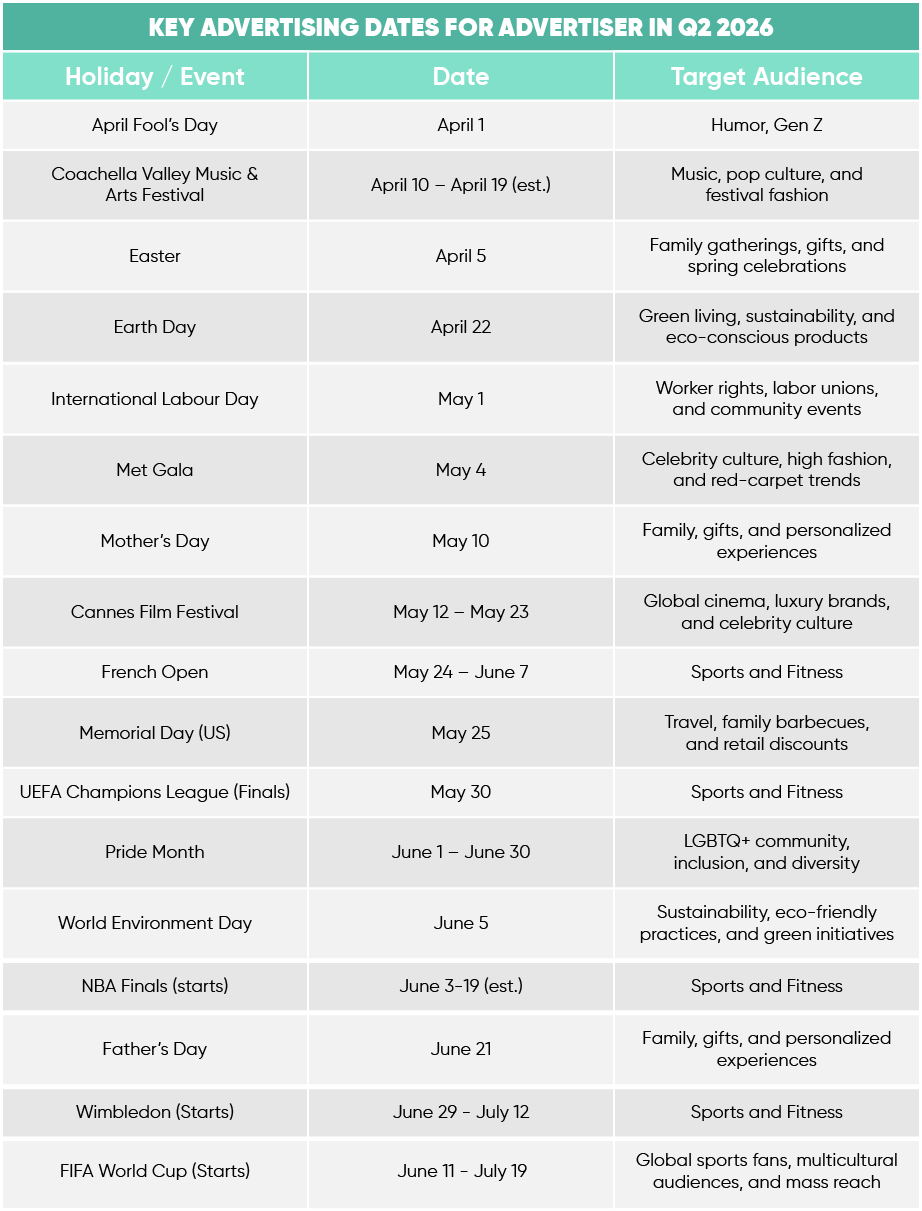
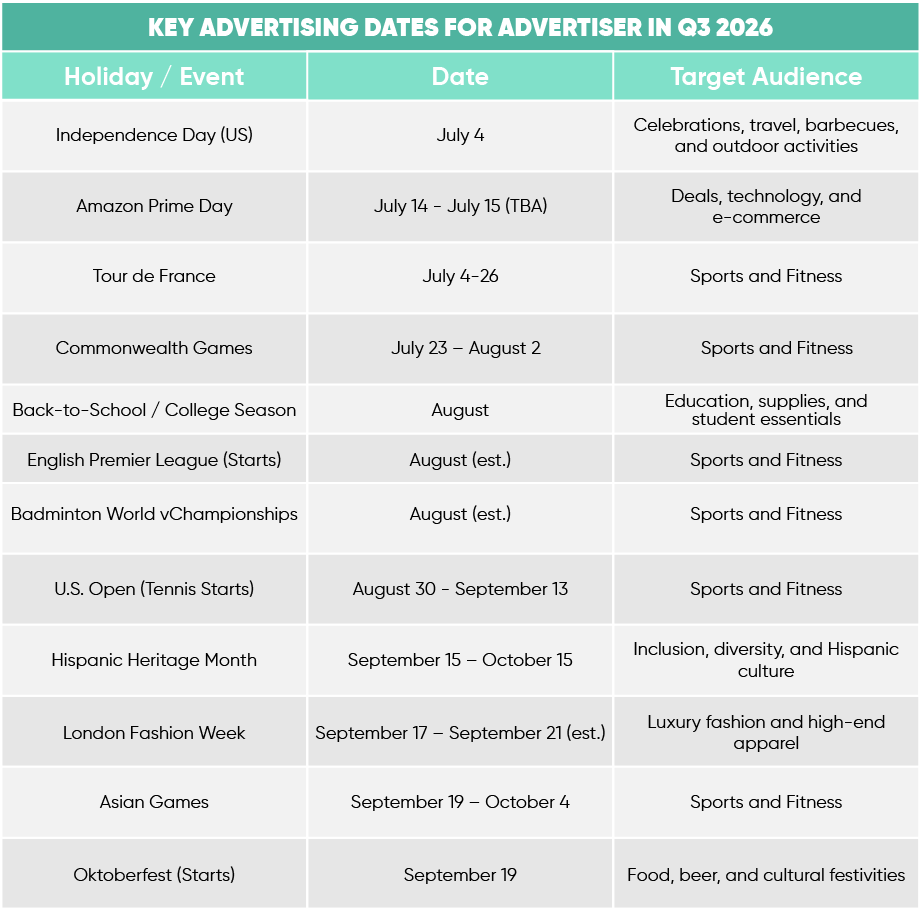
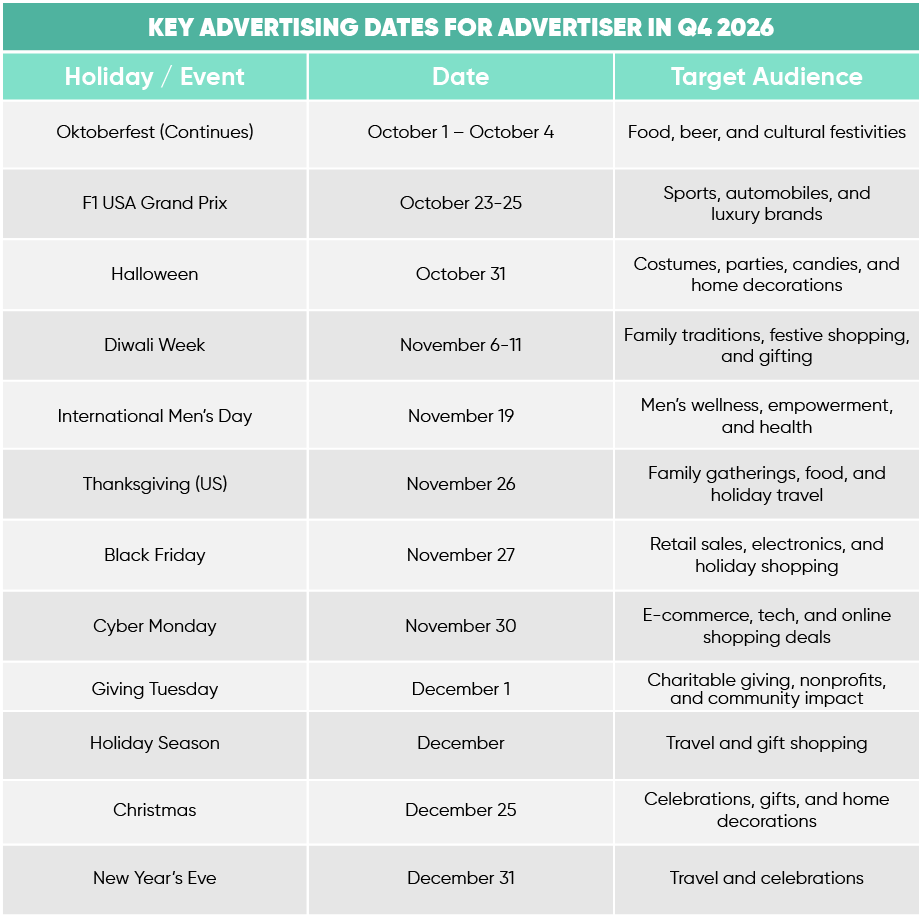
Here’s a comprehensive tentpole calendar for 2026 to plan campaigns that align with moments people are already excited about.
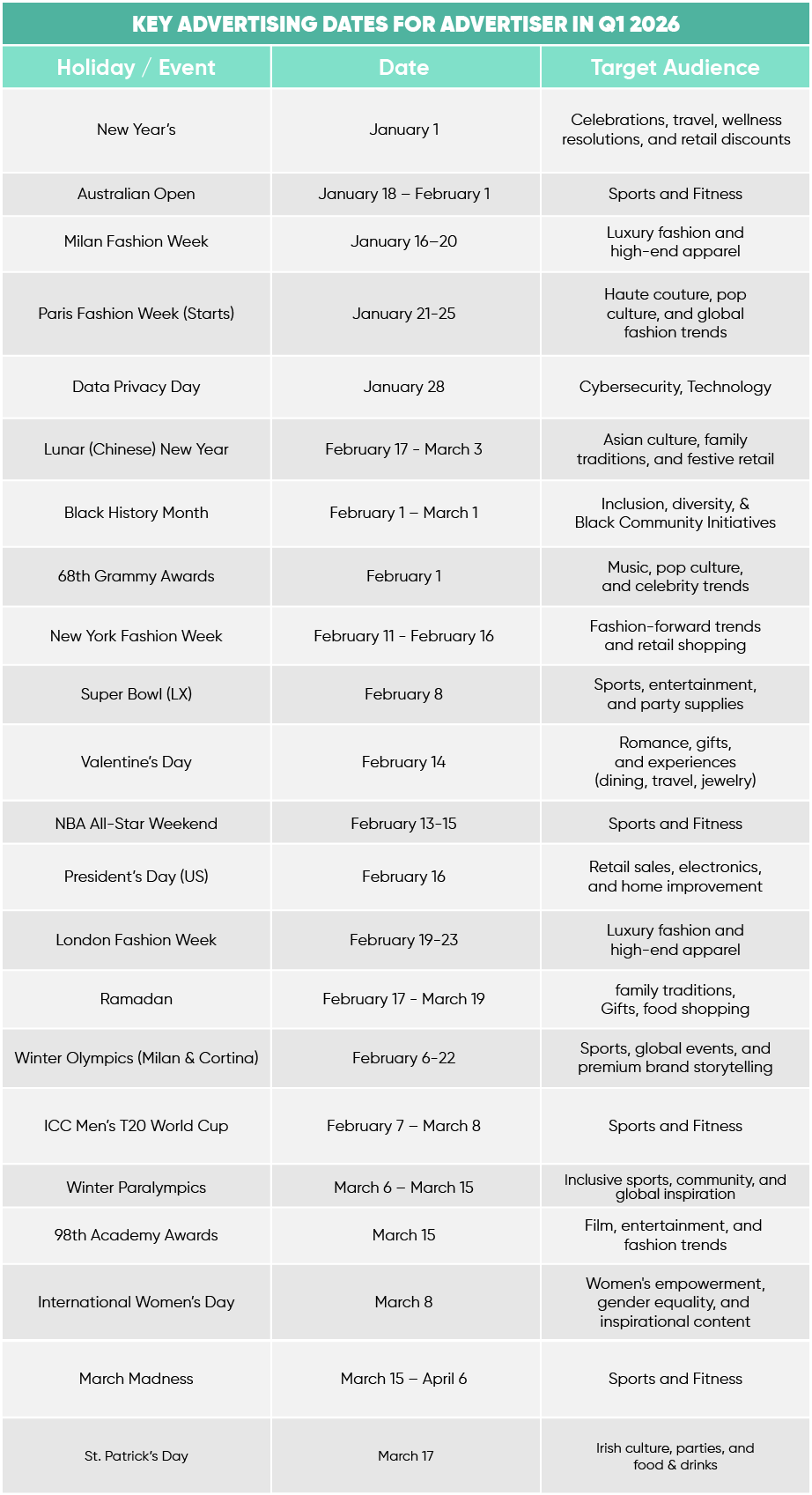
Holidays & Events in Q1 2026 (January, February, March)
The start of 2026 sets the pace for an intense year ahead. Q1 blends cultural observances, award season buzz, global fashion weeks, and major sporting events into a tightly packed quarter. With the Winter Olympics, cricket’s biggest tournament, and Ramadan beginning towards the end of the quarter, early-year campaign planning will be critical. This is the moment to establish brand presence, build momentum, and align with audiences as routines and attention patterns reset.
Holidays & Events in Q2 2026 (April, May, June)
Q2 brings renewed energy and marks the transition from cultural moments into one of the biggest sporting periods in recent history. With the FIFA World Cup 2026 kicking off in June, alongside spring festivals, family-led celebrations, and Pride Month, this phase of the 2026 advertising calendar offers a powerful mix of emotional storytelling and mass-reach opportunities. For brands thinking seriously about tentpole marketing, Q2 is where a well-timed tentpole strategy can help scale visibility while staying firmly rooted in cultural relevance.
Holidays & Events in Q3 2026 (July, August, September)
Summer gives ample leeway to connect with your audience, even in those moments when the season is seemingly slow. From Prime Day deal sprees, the excitement of Independence Day, and down to back-to-school shopping, Q3 is rich in tentpole events that drive engagement. Q3 is also a key period for meaningful tentpole campaigns because it hosts cultural milestones like Hispanic Heritage Month and the worldwide popularity of the English Premier League.
Holidays & Events in Q4 2026 (October, November, December)
Q4 is the crown jewel for your tentpole marketing effort. It is a time when the events around Halloween, Black Friday, and Cyber Monday light it all up for shoppers: anything from holiday shopping, including Diwali across various cultures, to New Year’s Eve. Your advertising calendar will be filled in fully, so make all these moments an opportunity to round up your year with flying colors in the last quarter of the year 2026.
Wrapping Up
Of the moving sands of tentpole marketing, flexibility, authenticity, and audience-focused approaches probably hold the largest potential for success. Monitor the real-time feedback of your audience’s participation and metrics to keep your campaigns relevant and impactful. By pointing your efforts toward 2026 tentpole events that echo values of greatest importance to them, trust is nurtured, and real connections are made.
And don’t forget to give equal time to analyzing and optimizing your campaigns by tracking those performance metrics, such as engagement rates and ROI. That way, you’ll be sure you’re not just part of the conversation but leading it. With a well-thought-out tentpole strategy, you’ll be able to make any event an opportunity to grow, connect, and inspire.
Let 2026 be the year your brand shines at moments that matter!
